Orion’s Quiver · Why we make memes
The Philosophy
of Memes
There's a very special joy in sharing laughs with others in your community and connecting over an inside joke. This website is a place to make those jokes, share them, and see what other people make of them.
The laughs matter in their own right. They also tell us something about this community: what we remember, how we see ourselves, and whether we’re comfortable enough to be a little ridiculous together.
I
A joke someone else can use
Richard Dawkins coined the word meme in The Selfish Gene in 1976. He used it for things that pass between people through imitation, such as tunes, ideas, and catchphrases. Internet memes give us a familiar example: someone makes a joke, someone else changes it, and the variations keep coming.
For a meme maker, the useful thing to notice is the pattern beneath the individual joke.
Take Drake turning away from one thing and approving another. The structure is simple: no to this, yes to that. Our version puts Instagram in the first panel and the Orion bow in the second. If you know the template, you can read the preference immediately, even if you still need to find out what Orion is.
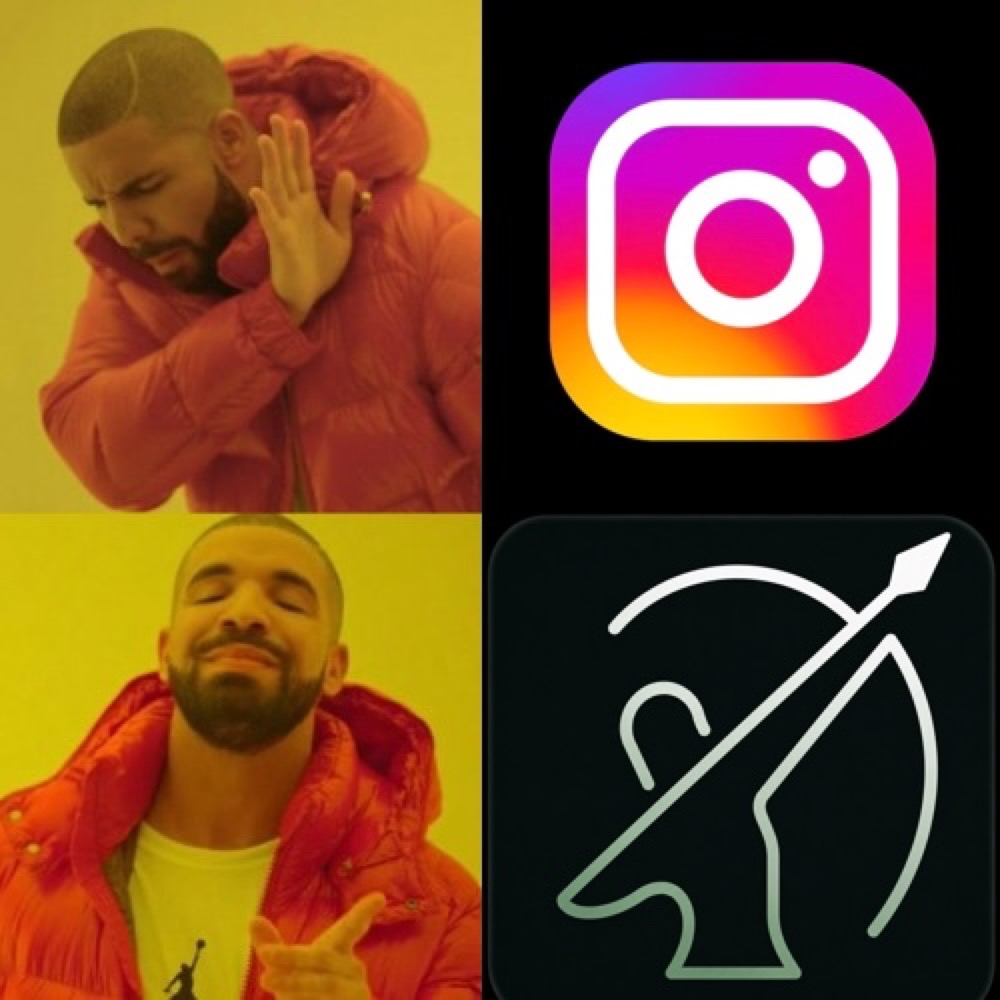
A one-off joke can be excellent. A reusable format offers something extra: the next person can see how to join in. Change the caption, replace an image, or use the same setup for something nobody has tried yet.
So alongside “Is it funny?”, ask: “Could somebody else make the next one?” The Quiver keeps source images within reach so they can.
Ease of sharing helps a meme spread. It doesn’t tell us whether the idea inside it is true or worth passing on.
II
The pleasure of recognising ourselves
An in-joke can bring back a whole conversation without retelling it. A gesture or a few words are enough if you remember what happened.
The board already has jokes about a “quick story” that isn’t quick, or checking the time and discovering that three hours have passed. People who recognise that experience bring their own memories to the caption. That’s part of the laugh.
Over time, these jokes become a kind of folk history. They preserve the details people chose to remember: a tangent, an expression, a habit that gradually became familiar.
That history should be open to newcomers. Nobody needs to get every reference to belong here. Sometimes a joke makes you feel at home; sometimes it makes you ask what you missed.
III
What the jokes tell us
A like tells you that someone reacted. It rarely tells you which part stayed with them.
A meme gives you more to go on. Someone picked a moment, paired it with an image, and decided what to say about it. Their caption shows how they understood what they saw. Other people’s versions can reveal an interpretation you hadn’t considered.
For a community gathered around Robert Edward Grant’s work, that matters. People can respond in their own language, with their own observations. A long conversation becomes the beginning of another one.
When Robert joins in or enjoys a joke about himself, that can help others feel comfortable contributing. It’s an encouraging response, while still leaving everyone room to say when a particular joke has gone too far.
IV
Funny, and true
Some memes make you laugh. Others catch something you’ve felt but haven’t put into words. A few manage both.
The board has seven reactions: 😹 🙏 🔥 💯 👁️ 👀 ♥️. In the Duel, any reaction is a vote for the meme you choose. The charts give particular reactions different jobs.
The People’s Chart ranks by 😹: how many people laughed.
Legendary combines 😹 with 👁️, the reaction for “it’s a joke and it’s true.” Here, “true” means someone recognises something in the joke. A reaction count can’t establish whether a factual claim is correct.
Legendary takes the square root of the two reaction counts multiplied together:
Legendary = √(😹 × 👁️)
| Example meme | 😹 Laughs | 👁️ Recognition | Legendary |
|---|---|---|---|
| More laughs, less recognition | 9 | 1 | 3.0 |
| Fewer laughs, more recognition | 4 | 6 | 4.9 |
These are illustrative numbers, not results from the board.
The first meme ranks higher on the People’s Chart. The second ranks higher on Legendary. Both received ten reactions across these two categories, but the second has a more even mix.
If either count is zero, the Legendary score is zero. Both kinds of response are needed. More reactions in both categories also raise the score, so it rewards a mix of responses as well as their number.
There’s room for both kinds of joke here. Legendary gives us another way to find something we might otherwise miss.
V
When a joke travels
Some jokes belong to the people who were there. Others work for someone who has never heard of Robert or Orion. Both are worth making.
If you want a meme to travel, give that second reader enough to understand it. A familiar format helps. So does a caption about an experience they recognise, even if the face in the image is new to them.
The “quick story” that turns into a long one is a good example. You don’t need to know the speaker to know the situation.
The practical part matters too. Finding the right image shouldn’t take longer than writing the joke. The Quiver holds the source material; the Maker lets you add your caption; the Board is where you can share the result.
A joke that reaches someone through a friend may make them curious about Orion. It has already done something worthwhile if it makes them laugh.
VI
Giving things a name
A useful name makes a source image easier to find and talk about. “The Side-Eye” or “Pyramid Hands” gives you something to look for when you have a caption in mind.
As people reuse an image, they may develop a shared sense of what it does well. They can also surprise each other by using it differently. That’s how a collection of pictures starts to acquire its own vocabulary.
Names help us pass that vocabulary on. A newcomer can browse the images, look at a few finished jokes, and have a go. Keep the names understandable and the examples easy to find.
VII
Leaving room for irreverence
When people admire a teacher, it can become awkward to tease them. Every remark starts to feel as though it ought to be serious. We’d like there to be room here for affection, disagreement, and a joke about a familiar gesture.
Robert appears throughout the Quiver, so jokes about him are a large part of the collection. The intention is to enjoy the recognisable moments in his work and the way we respond to them. That depends on the people involved being comfortable with the play.

Being the subject of a meme doesn’t give anyone a duty to enjoy it. Laughing at one joke doesn’t mean agreeing to every joke that follows. People can join in, set limits, or change their minds.
We can take someone’s work seriously and still laugh with them. Paying attention to their response is part of doing that well.
VIII
Laughing at ourselves
Our own habits are good material: the tangent we all follow, the question that sends us back to the beginning, the moment we realise how long we’ve been talking. A joke about something we share gives us a chance to recognise ourselves in it.
Singling out another member is different. If someone hasn’t agreed to be the subject of jokes, ask before making them one. Being present in the community isn’t an invitation to become its next punchline.
Anyone who wants to join in can say so and say what they’re comfortable with. If a joke lands badly, listen and be willing to take it down.
Before posting, think about how it will feel to the person in it. Will they recognise the affection or shared experience? Or will they feel that everyone else has been invited to laugh at them?
We want people to feel glad they were part of the moment we’re remembering.
IX
Be funny first
A meme shared by a friend can introduce someone to Orion. That’s a welcome result, but it doesn’t need to be the purpose of every joke.
If you’re making one, start with the thing that made you laugh. Give the caption some care. See what other people do with it. Some jokes will stay among the people who understand them; a few may travel much further.
The Quiver is here to give that a place to happen.